

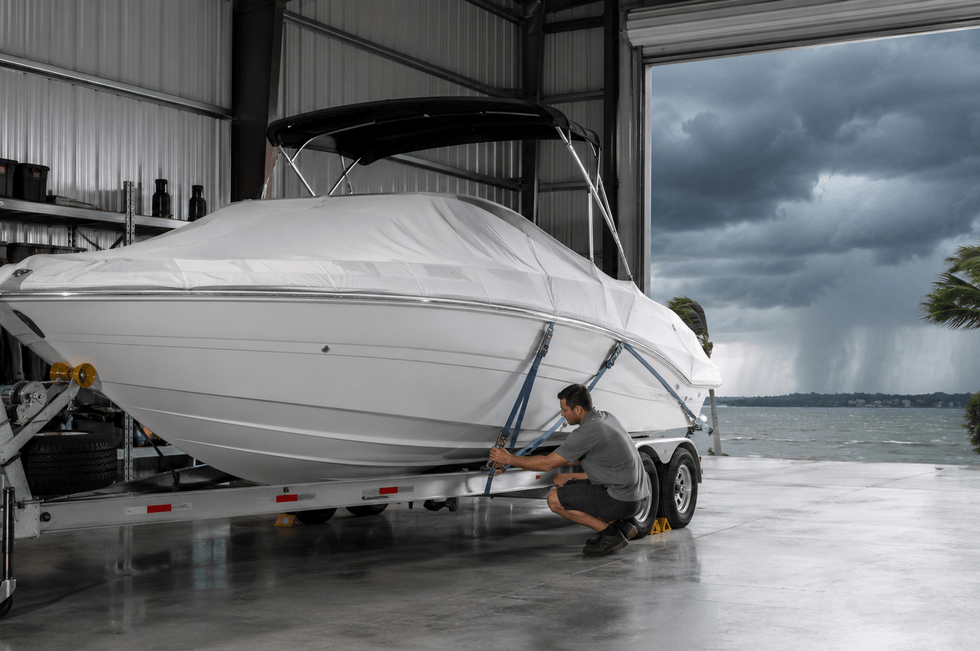
When a storm starts spinning in the Gulf, the countdown begins, and if your boat is stored on land here in Tampa, FL, a little preparation now can mean the difference between riding out the storm undamaged and facing a costly insurance claim afterward.
Here’s a complete, step-by-step checklist for getting your boat storm-ready while it’s on the trailer, plus answers to some of the most common questions boat owners ask us before a storm.
1. Strip It Down
Anything that can catch wind or rip loose becomes a hazard, both to your boat and to everything around it. Before the storm arrives:
- Remove all bimini tops, canvas covers, cushions, curtains, and sails. Loose fabric acts like a sail and can tear your boat off its tie-downs.
- Take out electronics, fishing gear, and anything stored in compartments. Rain and flying debris can destroy or trigger flooding through open hatches, and loose gear inside the boat can shift and cause damage.
- Clear anything that can catch the wind or become a projectile. Rod holders, flags, antennas, and loose deck items should all come off or be stowed securely. A flying seat cushion is annoying. A flying antenna at 100 mph is dangerous to every boat and vehicle around it.
2. Secure the Boat to the Trailer
Your goal is to turn the boat and trailer into a single, solid unit that won’t shift, bounce, or tip.
- Use heavy-duty tie-down straps to connect the boat directly to the trailer frame, not just the winch strap at the bow.
- Strap down both the bow and the stern tightly so the boat can’t rock or lift at either end.
- Block the wheels. Place solid blocks between the trailer frame members and the axle, and chock each wheel, to keep the trailer from rolling or bouncing.
- Let some air out of the tires. Deflating trailer tires to about half pressure lowers the boat’s center of gravity and reduces bouncing in high wind. For a lightweight boat/trailer combo, consider adding water to the bilge (within manufacturer limits) to add stabilizing weight.
- Handle the drain plug correctly.
- Outboard motors: leave the drain plug in.
- Inboard setups: pull the drain plug so rainwater doesn’t pool in the bilge and flood the engine compartment.
3. Seal Openings
- Seal hatches with duct tape or plastic wrap to keep wind-driven rain out.
- Shut off fuel lines, electrical circuits, and gas supply.
4. Disconnect and Protect the Electrical System
While you’re securing the boat, it’s also worth disconnecting the battery (or batteries) to prevent electrical shorts from storm-driven rain and humidity, and to eliminate any risk of an onboard fire while the boat sits unattended. If the battery stays in place, make sure terminals are covered and connections are dry.
5. Document Everything for Insurance
Prep isn’t just physical. It’s paperwork too, and this step is easy to skip when you’re rushing.
- Take clear, current photos of the boat and trailer from multiple angles, including any existing dings, scratches, or wear. This creates a “before” record that makes post-storm claims faster and cleaner.
- Confirm your policy is active and covers named storms. Many marine policies have separate windstorm or named-storm deductibles, and some require you to prove you took “reasonable precautions” (like the steps above) before a claim will be honored. A quick call to your agent now can save a major headache later.
- Store copies of your registration, insurance, and recent surveys in a waterproof container, and consider taking them home with you rather than leaving them on the boat.
Recent Comments